
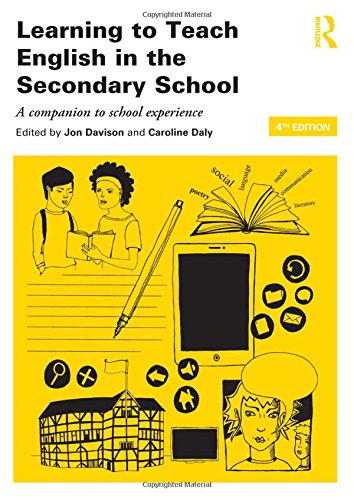
Learning to teach English in the secondary school : a companion to school experience / edited by Jon Davison and Caroline Daly.
Series: Learning to teach subjects in the secondary school seriesPublisher: New York : Routledge, 2014Copyright date: ©2014Edition: Fourth editionDescription: xxiii, 257 pages ; 26 cmContent type:- text
- unmediated
- volume
- 9780415840286 (hardback)
- 0415840287 (hardback)
- 9780415840293 (paperback.)
- 0415840295 (paperback.)
| Item type | Current library | Home library | Call number | Materials specified | Copy number | Status | Date due | Barcode | |
|---|---|---|---|---|---|---|---|---|---|
| AM | PERPUSTAKAAN TUN SERI LANANG | PERPUSTAKAAN TUN SERI LANANG KOLEKSI AM-P. TUN SERI LANANG (ARAS 5) | LB1631.L333 2014 (Browse shelf(Opens below)) | 1 | Available | 00002142463 |
Includes bibliographical references : (p. 237-246) and index.
Machine generated contents note: 1. Which English? / John Moss -- introduction: where are you coming from? -- the diversity of English -- the Cox Report's five views of English -- consensus or compromise? -- principled positions -- the National Curriculum -- futures -- summary and key points -- further reading -- 2. Battles For English 1894--2014 / Jon Davison -- introduction -- the nineteenth century -- English and the Board of Education -- the Newbolt Report -- the 1930s -- Leavis -- English teaching postwar -- English from 5 to 16 -- Kingman cometh -- Language in the National Curriculum Project -- the Cox Report -- 1990--2014 -- summary and key points -- further reading -- 3. English As A Curriculum Subject / John Yandell -- introduction -- the scope of English -- the story of the National Curriculum -- framing the subject: the purposes of English -- the choice of text -- planning -- planning at KS4 -- summary and key points -- further reading -- useful websites.
Contents note continued: 4. Speaking And Listening / Gabrielle Cliff Hodges -- introduction -- observing speaking and listening -- exploring differences between spoken and written language -- exploring variety in spoken language -- planning and organising classrooms for speaking and listening -- speaking and listening and ICT -- progression and assessment in speaking and listening -- summary and key points -- further reading -- acknowledgements -- 5. Reading / Caroline Daly -- introduction -- reading in the National Curriculum -- making meanings out of texts -- reading strategies: individual, group, whole class -- supporting progression: reading the unfamiliar -- assessment -- summary and key points -- further reading -- 6. Writing / Gill Anderson -- introduction -- getting writing going -- speaking, listening, reading and writing -- audiences, purposes and genres -- debates about the teaching of writing -- responding to writing -- summary and key points -- further reading.
Contents note continued: website -- acknowledgement -- 7. Teaching Language And Grammar / Anne Turvey -- introduction -- grammar: implicit and explicit knowledge about language -- grammar: making use of a shared metalanguage -- exploring use and theorising structure -- analysing language in literature and in Children's writing -- summary and key points -- further reading -- 8. Media Education And Ict In English / Rob Mcinnes -- introduction -- English and media: the Simpsons incident -- w(h)ither media education? -- framing media education -- media literacy -- English and ICT -- students' learning and attainment -- summary and key points -- further reading and resources -- 9. Working With Digital Technologies / Theo Bryer -- introduction -- the digital revolution -- some history -- addressing an audience -- the National Curriculum -- processes involved -- media -- production -- filming strategies -- editing -- summary and key points -- further reading.
Contents note continued: 10. Drama In Teaching And Learning English / Theo Bryer -- introduction -- drama in the curriculum -- drama in education -- some history -- drama in your English classroom -- summary and key points -- further reading -- 11. Approaching Shakespeare / Anton Franks -- introduction -- starting points -- knowledge, attitudes and obstacles -- historical contexts -- the text: playwright, company and the conditions of production -- authenticity and interpretation -- assessment -- summary and key points -- further reading -- resources for teachers and teaching -- 12. Possibilities With Poetry / Gabrielle Cliff Hodges -- introduction -- the need for a rationale -- planning poetry lessons -- poetry across the age range -- early Key Stage 3: the pleasures of poetry -- later in Key Stage 3: focusing on interpretation -- entering Key Stage 4: the challenges of criticism -- summary and key points -- note -- further reading -- 13. Advanced Level English / Barbara Bleiman.
Contents note continued: introduction -- changes and developments in Advanced Level English -- an overview -- understanding the assessment objectives, knowing your awarding board specification -- classroom approaches -- encouraging independence and developing skills -- alternative interpretations -- the contexts in which texts are written and received -- the Writer's craft -- Language and Literature A Level -- IB, Pre-U and Creative Writing A Level -- summary and key points -- further reading -- 14. Critical Practice / Caroline Daly -- introduction -- student teacher development -- monitoring development -- developing roles and relationships -- reflection -- summary and key points -- note -- further reading.
How do you approach teaching English in the contemporary classroom? What is expected of a would-be English teacher? The fourth edition of this best-selling text combines theory and practice to present an indispensable introduction to the opportunities and challenges of teaching English in the secondary classroom. It offers insight into the history, policies and definitions surrounding the subject, together with innovative and practical strategies which can be used for effective teaching and learning. Already a major text for many university teacher education courses, the new edition reflects the extent and impact of current reforms whilst retaining its focus on what is of enduring value for English teaching.
There are no comments on this title.