
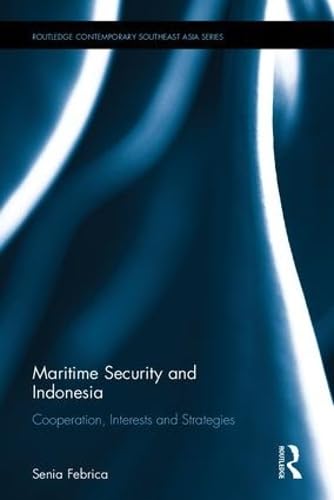
Maritime security and Indonesia : cooperation, interests and strategies / Senia Febrica.
Series: Routledge contemporary Southeast Asia series ; 86.Publisher: London : Routledge Taylor & Francis Group [2017]Copyright date: ©2017Description: xiv, 231 pages ; 24 cmContent type:- text
- unmediated
- volume
- 9781138688438
- spine title : Maritime security and Indonesia
| Item type | Current library | Home library | Call number | Materials specified | Copy number | Status | Date due | Barcode | |
|---|---|---|---|---|---|---|---|---|---|
| KOLEKSI ASIA TENGGARA | PERPUSTAKAAN TUN SERI LANANG | PERPUSTAKAAN TUN SERI LANANG KOLEKSI ASIA TENGGARA-P. TUN SERI LANANG (ARAS 5) | VK203.F434 kat (Browse shelf(Opens below)) | 1 | Available | 00002195684 |
Includes bibliographical references and index.
Maritime security and Indonesia -- Domestic politics -- When the hegemon is not leading -- When shared identity does not matter -- Gains and losses.
'Indonesia is the largest archipelago state in the world comprising 17,480 islands, with a maritime territory measuring close to 6 million square kilometres. It is located between the two key shipping routes of the Pacific and Indian Ocean. Indonesia's cooperation in maritime security initiatives is vitally important because half of the world's trading goods and oil pass through Indonesian waters, including the Straits of Malacca, the Strait of Sunda and the Strait of Lombok. This book analyses Indonesia's participation in international maritime security cooperation. Using Indonesia as a case study, the book adopts mixed methods to assess emerging power cooperation and non-cooperation drawing from various International Relations theories and the bureaucratic politics approach. It addresses not only the topic of Indonesia's cooperation but also engages in debates across the International Relations, political science and policy studies disciplines regarding state cooperation. Based on extensive primary Indonesian language sources and original interviews, the author offers a conceptual discussion on the reasons underlying emerging middle power participation or non-participation in cooperation agreements. The analysis offers a fresh perspective on the growing problems of maritime terrorism and sea robbery and how an emerging power deals with these threats at unilateral, bilateral, regional and multilateral levels. The book fills a significant gap in literature on Indonesian foreign policy making in the post-1998 era'-- Provided by publisher.
There are no comments on this title.