
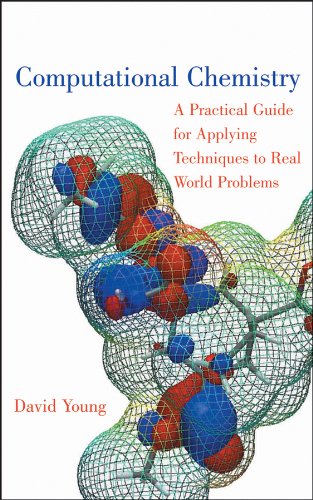
Computational chemistry : a practical guide for applying techniques to real world problems / David C. Young.
Publication details: New York : Wiley, ©2001.Description: 1 online resource (xxiv, 381 pages) : illustrationsContent type:- text
- computer
- online resource
- 0471458430
- 9780471458432
- 9780471220657
- 0471220655
- 542/.85 22
- QD39.3.M3 Y68 2001eb
| Item type | Current library | Home library | Call number | Materials specified | Copy number | Status | Date due | Barcode | |
|---|---|---|---|---|---|---|---|---|---|
| AM | PERPUSTAKAAN TUN SERI LANANG | PERPUSTAKAAN TUN SERI LANANG KOLEKSI AM-P. TUN SERI LANANG (ARAS 5) | ebook (Browse shelf(Opens below)) | 1 | Available |
Includes index.
Includes bibliographical references and index.
PREFACE; ACKNOWLEDGMENTS; SYMBOLS USED IN THIS BOOK; 1. Introduction; 1.1 Models, Approximations, and Reality; 1.2 How Computational Chemistry Is Used; Bibliography; Part I. BASIC TOPICS; 2. Fundamental Principles; 3. Ab initio Methods; 4. Semiempirical Methods; 5. Density Functional Theory; 6. Molecular Mechanics; 7. Molecular Dynamics and Monte Carlo Simulations; 8. Predicting Molecular Geometry; 9. Constructing a Z-Matrix; 10. Using Existing Basis Sets; 11. Molecular Vibrations; 12. Population Analysis; 13. Other Chemical Properties; 14. The Importance of Symmetry.
A practical, easily accessible guide for bench-top chemists, this book focuses on accurately applying computational chemistry techniques to everyday chemistry problems. Provides nonmathematical explanations of advanced topics in computational chemistry. Focuses on when and how to apply different computational techniques. Addresses computational chemistry connections to biochemical systems and polymers. Provides a prioritized list of methods for attacking difficult computational chemistry problems, and compares advantages and disadvantages of various approximation techniques. Describes how the c.
Print version record.
There are no comments on this title.