
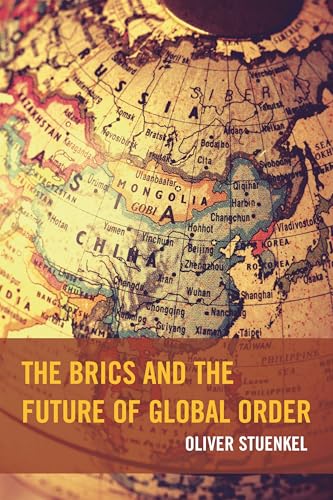
Amazon cover image
Image from Amazon.com

The BRICS and the future of global order / Oliver Stuenkel

By: Publisher: Lanham, Maryland ; Boulder, New York : Lexington Books, [2015]Description: xiv, 213 pages ; 24 cmContent type:
  • text
Media type:
  • unmediated
Carrier type:
  • volume
ISBN:
  • 9780739193211
  • 073919321X
  • 9781498512749
  • 1498512747
Subject(s): DDC classification:
  • 337.09172/4 23
Contents:
Capturing the spirit of a decade (2001-2006) -- The financial crisis, contested legitimacy and the genesis of intra-BRICs cooperation (2006-2008) -- From Yekaterinburg to Brasília : the new epicenter of world politics? (2009-2010) -- Enter South Africa: from BRICs to BRICS -- The hidden world of intra-BRICS cooperation : does regime type matter? -- Delhi, Durban and Fortaleza : the BRICS bank and the contingency reserve arrangement (2012-2014) -- The BRICs in the UNSC : the case of R2P -- The BRICs grouping and the future of global order -- Appendix 1: High-level summits -- Appendix 2: Timeline of events
Summary: 'The transformation of the BRIC acronym from an investment term into a household name of international politics and, more recently, into a semi-institutionalized political outfit (called BRICS, with a capital'S'), is one of the defining developments in international politics in the past decade. While the concept is now commonly used in the general public debate and international media, there has not yet been a comprehensive and scholarly analysis of the history of the BRICS term. The BRICS and the Future of Global Order offers a definitive reference history of the BRICS as a term and as an institution--a chronological narrative and analytical account of the BRICS concept from its inception in 2001 to the political grouping it is today. In addition, it analyzes what the rise of powers like Brazil, Russia, India, China, and South Africa means for the future of global order. Will the BRICS countries seek to establish a parallel system with its own distinctive set of rules, institutions, and currencies of power, rejecting key tenets of liberal internationalism, or will they seek to embrace the rules and norms that define today's Western-led order?'--Publisher's description
Tags from this library: No tags from this library for this title. Log in to add tags.
Star ratings
    Average rating: 0.0 (0 votes)
No physical items for this record

Includes bibliographical references (pages 185-203) and index

Capturing the spirit of a decade (2001-2006) -- The financial crisis, contested legitimacy and the genesis of intra-BRICs cooperation (2006-2008) -- From Yekaterinburg to Brasília : the new epicenter of world politics? (2009-2010) -- Enter South Africa: from BRICs to BRICS -- The hidden world of intra-BRICS cooperation : does regime type matter? -- Delhi, Durban and Fortaleza : the BRICS bank and the contingency reserve arrangement (2012-2014) -- The BRICs in the UNSC : the case of R2P -- The BRICs grouping and the future of global order -- Appendix 1: High-level summits -- Appendix 2: Timeline of events

'The transformation of the BRIC acronym from an investment term into a household name of international politics and, more recently, into a semi-institutionalized political outfit (called BRICS, with a capital'S'), is one of the defining developments in international politics in the past decade. While the concept is now commonly used in the general public debate and international media, there has not yet been a comprehensive and scholarly analysis of the history of the BRICS term. The BRICS and the Future of Global Order offers a definitive reference history of the BRICS as a term and as an institution--a chronological narrative and analytical account of the BRICS concept from its inception in 2001 to the political grouping it is today. In addition, it analyzes what the rise of powers like Brazil, Russia, India, China, and South Africa means for the future of global order. Will the BRICS countries seek to establish a parallel system with its own distinctive set of rules, institutions, and currencies of power, rejecting key tenets of liberal internationalism, or will they seek to embrace the rules and norms that define today's Western-led order?'--Publisher's description

There are no comments on this title.

to post a comment.

Contact Us

Perpustakaan Tun Seri Lanang, Universiti Kebangsaan Malaysia
43600 Bangi, Selangor Darul Ehsan,Malaysia
+603-89213446 – Consultation Services
019-2045652 – Telegram/Whatsapp
Email: helpdeskptsl@ukm.edu.my

Copyright ©The National University of Malaysia Library