
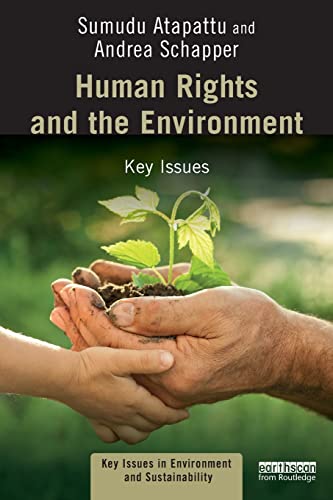
Human rights and the environment : key issues / by Sumudu Atapattu and Andrea Schapper.
Series: Key issues in environment and sustainabilityPublisher: Abingdon, Oxon : Routledge, 2019Copyright date: ©2019Description: xxv, 358 pages ; 24 cmContent type:- text
- unmediated
- volume
- 9781138722750
| Item type | Current library | Home library | Call number | Materials specified | Copy number | Status | Date due | Barcode | |
|---|---|---|---|---|---|---|---|---|---|
| AM | PERPUSTAKAAN UNDANG-UNDANG | PERPUSTAKAAN UNDANG-UNDANG KOLEKSI AM-P. UNDANG-UNDANG | C39.21.A864 2019 2 (Browse shelf(Opens below)) | 1 | Available | 00002244683 |
Includes bibliographical references and index.
Human rights and environmental protection : framing the issues -- Emergence of a human right to a healthy environment -- Pros and cons of a human rights-based approach to environmental protection -- Regional developments -- Substantive rights -- Procedural rights -- Constitutional developments -- Selected national cases -- From UNFCCC to Paris agreement : a human rights assessment -- Social movements and civil society -- Vulnerability and climate change -- Mitigation, adaptation, and loss and damage -- Extraterritorial application of environmental rights -- Business, human rights and the environment -- Intergenerational rights, animal rights, and the rights of nature and ecosystems -- Human rights and environment : square pegs in round holes?
The field of human rights and the environment has grown phenomenally during the last few years and this textbook will be one of the first to encourage students to think critically about how many environmental issues lead to a violation of existing rights. Taking a socio-legal approach, this book will provide a good understanding of both human rights and environmental issues, as well as the limitations of each regime, and will explore the ways in which human rights law and institutions can be used to obtain relief for the victims of environmental degradation or of adverse effects of environmental policies. In addition, it will place an emphasis on climate change and climate policies to highlight the pros and cons of using a human rights framework and to underscore its importance in the context of climate change. As well as identifying emerging issues and areas for further research, each chapter will be rich in pedagogical features, including web links to further research and discussion questions for beyond the classroom. Combining their specialisms in law and politics, Atapattu and Schapper have developed a truly inter-disciplinary resource that will be essential for students of human rights, environmental studies, international law, international relations, politics, and philosophy.
There are no comments on this title.