
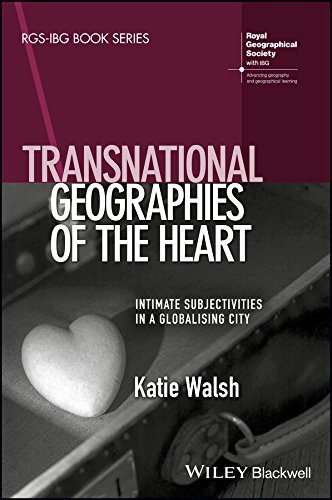
Transnational geographies of the heart : intimate subjectivities in a globalising city / Katie Walsh.
Series: RGS-IBG book seriesPublisher: Hoboken, NJ : John Wiley & Sons, Ltd, 2018Copyright date: ©2018Description: 1 online resourceContent type:- text
- computer
- online resource
- 9781119050414
- 1119050413
- 305.82/105357 23
- DS219.B75 W35 2018
Includes bibliographical references and index.
Intro; Title Page; Copyright Page; Contents; Series Editor's Preface; Acknowledgements; Chapter One Introduction; British Global Mobilities; Postcolonial Histories, Cities, Migrations; Theorising Transnationalism: From the Global to the Intimate; Approaching Intimacy: The Structure of the Book; Notes; Chapter Two Geographies of Intimacy; Families and'Family Life'; Geographies of Friendship; Couple Ties: Heteronormativity, Governance, and Love; Intimacy and the Sociological Study of Personal Life; Intimacies, Subjectivities, Spatialities; Note.
Chapter Three A Globalising Gulf Region and the British in DubaiMigration and Development of the GCC Region; Citizenship, Kafala, and the Temporary Migrant Worker; Social Stratification and Migrant Subjectivities in Dubai and the Gulf; Researching British Migration in Dubai, 2002-2004; A Reflexive Note; Chapter Four British'Expatriate' Subjectivities in Dubai; British Imaginaries of Dubai and Emirati'Culture';'Culture Shock' and Emotional Resources of Whiteness; The Spatialisation of an'Expat' Lifestyle; Encounters with Low-income Migrants; Conclusion.
Chapter Five'Community', Clubs and Friendship'Britishness' and Club Life; Heterogeneity within the British'Community'; Belonging, Leisure, and the Significance of'Play'; Coffee Mornings or Adventures for'Expat Mums'; Transnational Mobilities and Friendships; Friends as Family; Conclusion; Chapter Six Sex, Desire and Romance in the Globalising City; Heteronormativity and the UAE's'Decency Laws'; Race, Affluence and Masculinity in Transnational Space; Dubai's'Global Nightscapes'; Dubai: No Place for Romance?; Conclusion; Chapter Seven Migration, Domesticity and'Family Life'
'Family Time' and Space for FamilyGlobal Work, Expatriation and Marriage; Adult Children and the Family Home; Transnational Connections and Family'Left Behind'; Conclusion; Chapter Eight Our Intimate Lives; Exploring the Spatialisation of Intimacy; Changing Gulf Subjectivities: Temporalities of Intimacy; Intimacy, Belonging and Home: Rethinking the Global City; References; Index; EULA.
Transnational Geographies of the Heart explores the spatialisation of intimacy in everyday life through an analysis of intimate subjectivities in transnational spaces. The author draws on ethnographic research with British migrants in Dubai, United Arab Emirates, during a phase of rapid globalisation and economic diversification in 2002-2004. This research highlighted the negotiation of inter-personal relationships as enormously significant in relation to the dialectic of home and migration. A range of relationships are discussed in four empirical chapters focused on the production of'expatriate' subjectivities, community and friendships, sex and romance, and families. The British migrants interviewed are diverse in terms of their length of residence, occupation, age, gender and marital status yet, at the same time, their reproduction of middle class, white and heteronormative subjectivities in postcolonial space marks them as privileged in collective terms. Essential reading for geographers, sociologists and anthropologists, this book demonstrates that a critical analysis of the geographies of intimacy might productively contribute to our understanding of the ways in which intimate subjectivities are embodied, emplaced, and co-produced across binaries of public/private and local/global space. --Book Jacket.
Online resource; title from digital title page (viewed on May 24, 2018).
There are no comments on this title.