
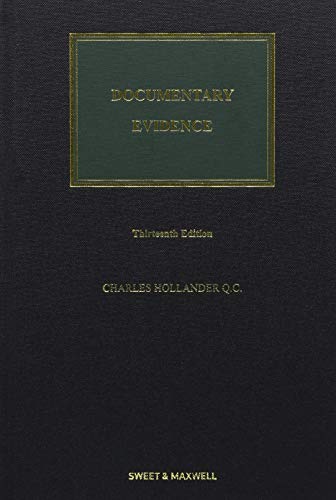
Documentary evidence / Charles Hollander.
Publisher: London : Thomson Reuters, trading as Sweet & Maxwell, 2018Copyright date: ©2018.Edition: Thirteenth editionDescription: lxxix, 636 pages ; 24 cmContent type:- text
- unmediated
- volume
- 9780414069473
| Item type | Current library | Home library | Call number | Materials specified | Copy number | Status | Date due | Barcode | |
|---|---|---|---|---|---|---|---|---|---|
| AM | PERPUSTAKAAN UNDANG-UNDANG | PERPUSTAKAAN UNDANG-UNDANG KOLEKSI AM-P. UNDANG-UNDANG | C11.7KD.H635 2018 2 (Browse shelf(Opens below)) | 1 | Available | 00002183944 |
Includes bibliographical references and index.
Pre-action disclosure from the opposing party; -- Early disclosure in the proceedings from the opposing party; -- Disclosure from non-parties and witnesses; -- Disclosure from facilitators: Norwich Pharmacal; -- Other rights of access to documents; -- Access to court documents; -- Disclosure; -- Practicalities of CPR disclosure; -- Electronic disclosure; -- Objections to disclosure and inspection; -- Failure and abuse of disclosure obligations; -- Privilege: A fundamental right; -- Privilege: General principles; -- Privilege: Communications between which persons; -- Claiming privilege; Privilege: Problem areas; -- Legal advice privilege; -- Litigation privilege; -- Privilege deriving from joint and common interest; -- Without prejudice privilege; -- Privilege against self-incrimination; -- Public interest immunity; -- Waiver of privilege; -- Limited, selective and implied waiver; -- Loss of privilege through inadvertence and fraud; -- Exclusion of documentary evidence; -- The collateral undertaking; -- The international element; -- Witness statements and other written evidence; -- Expert reports; -- The Civil Evidence Act 1995; -- Powers of investigation.
'Now in its 13th edition, Documentary Evidence is a comprehensive guide to the legal obligations of disclosure. Logically presented and lucidly written, it provides detailed analysis and sensible practical advice. Following a chronological structure, it shows when and how a practitioner should take action in relation to the obligation to disclose. It is a standard work that is often cited in court judgments. Under the Civil Procedure Rules the parties to an action are encouraged to adopt a'cards-on-the-table' approach toward the exchange of information, not just once litigation has commenced but before as well. It is likely in the early stages that a few documents will be identified as being relevant or key to the matter at hand. These will be used to provide advice as to the merit or not of proceeding with the dispute. If the decision is taken to proceed, the law imposes a requirement to make full and proper disclosure, which is the process whereby the parties to an action disclose to each other all documents in their possession, custody or power relating to matters in question in the action. This title deals with the nature and scope of the obligation to disclose.'--Publisher's website.
There are no comments on this title.