
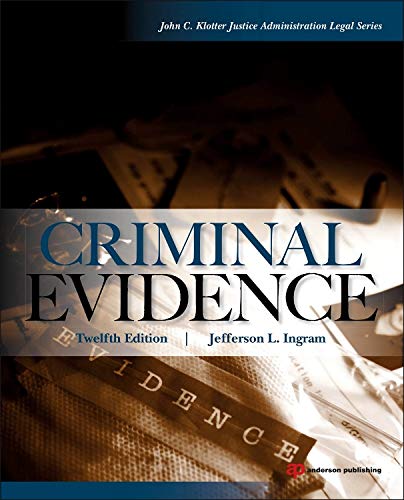
Criminal evidence / Jefferson L. Ingram, John C. Klotter Justice Administration legal series.
Publisher: Waltham, MA : Anderson, [2015]Copyright date: ©2015Edition: 12th editionDescription: xix, 1054 pages ; 25 cmContent type:- text
- unmediated
- volume
- 9780323294584
| Item type | Current library | Home library | Call number | Materials specified | Copy number | Status | Date due | Barcode | |
|---|---|---|---|---|---|---|---|---|---|
| AM | PERPUSTAKAAN UNDANG-UNDANG | PERPUSTAKAAN UNDANG-UNDANG KOLEKSI AM-P. UNDANG-UNDANG | C31.7KF.I535 2015 2 (Browse shelf(Opens below)) | 1 | Available | 00002184584 |
Includes bibliographical references and index.
Machine generated contents note: Part I History and Approach to Study 1. History and Development of Rules of Evidence 2. Approach to the Study of Criminal Evidence Proof by Evidence and Substitutes 3. Burden of Proof 4. Proof via Evidence 5. Judicial Notice 6. Presumptions, Inferences, and Stipulations General Admissibility Tests 7. Relevancy and Materiality 8. Competency of Evidence and Witnesses Evidence via Witness Testimony 9. Examination of Witnesses 10. Privileges 11. Opinions and Expert Testimony 12. Hearsay Rule and Exceptions Evidence via Documents and Real Evidence 13. Documentary Evidence 14. Real Evidence 15. Results of Examinations and Tests Exclusion of Evidence on Constitutional Grounds 16. Evidence Unconstitutionally Obtained Part II Judicial Decisions Relating to Part I Glossary Appendix I: Federal Rules of Evidence for United States Courts and Magistrates Appendix II: Table of Jurisdictions in which Uniform Rules of Evidence have been Adopted
'Criminal Evidence is a well-respected and trusted introduction to the rules of criminal evidence for criminal justice students and professionals. The first half of this book follows the Federal Rules of Evidence in its explanation of how evidence is collected, preserved, and presented in criminal court. The second half provides a selection of relevant criminal court cases that reinforce these basics and provide the context of how these rules are currently practiced. Readers will have an understanding of how concepts of evidence operate to convict the guilty and acquit the innocent. Part of the John C. Klotter Justice Administration Legal Series, this twelfth edition provides many updates, new references to recent cases, and a current version of the Federal Rules of Evidence. Student aids include chapter outlines, key terms and concepts lists, a glossary, a table of cases cited, and online interactive case studies. Teacher resources include Instructor's Guide, test bank, and PowerPoint slides'-- Provided by publisher.
There are no comments on this title.