
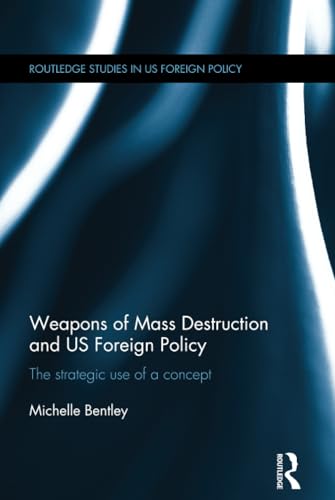
Weapons of mass destruction and US foreign policy : the strategic use of a concept / Michelle Bentley.
Series: Routledge studies in US foreign policyPublisher: New York : Routledge, 2014Copyright date: ©2014Description: xii, 178 pages ; 24 cmContent type:- text
- unmediated
- volume
- 9780415830188
- spine title : Weapons of mass destruction and US foreign policy
| Item type | Current library | Home library | Call number | Materials specified | Copy number | Status | Date due | Barcode | |
|---|---|---|---|---|---|---|---|---|---|
| AM | PERPUSTAKAAN TUN SERI LANANG | PERPUSTAKAAN TUN SERI LANANG KOLEKSI AM-P. TUN SERI LANANG (ARAS 5) | U793.B384W437 (Browse shelf(Opens below)) | 1 | Available | 00002154017 |
Includes bibliographical references and index.
'This book examines the use of concepts specifically weapons of mass destruction (WMD) in US foreign policy and national security discourse. Current analysis of WMD definition has made headway into identifying the repercussions that the conceptual conflation of such diverse weapons typically understood as a reference to nuclear, biological and chemical weapons has for international security. While the concept assumes these weapons are equal, the vast disparity between them, and their disparity from the conventional weapons from which they are supposedly distinct, means this approach is seen as unreflective of reality, causing miscalculations in security policy. Not least, this has highlighted that the issue of WMD definition is a priority concern where this has direct implications for strategy. Weapons of Mass Destruction and US Foreign Policy argues that understanding WMD is not a search for a single interpretation, but one that seeks to comprehend what the concept means at any given time, especially where this relates to the political circumstances of its use. By identifying the different ways in which WMD has been defined, the book constructs a dynamic view of conceptual meaning that recognises and, more importantly explains, the inherent diversity in interpretation as the consequence of epistemic and institutional context.This book will be of much interest to students of Weapons of Mass Destruction, US foreign and security policy, strategic studies and IR.'-- Provided by publisher.
'This book examines the use of concepts - specifically'weapons of mass destruction' (WMD) - in US foreign policy and national security discourse. Current analysis of WMD definition has made headway into identifying the repercussions that the conceptual conflation of such diverse weapons - typically understood as a reference to nuclear, biological and chemical weapons - has for international security. While the concept assumes these weapons are'equal', the vast disparity between them, and their disparity from the conventional weapons from which they are supposedly distinct, means this approach is seen as unreflective of reality, causing miscalculations in security policy. Not least, this has highlighted that the issue of WMD definition is a priority concern where this has direct implications for strategy. Weapons of Mass Destruction and US Foreign Policy argues that understanding WMD is not a search for a single interpretation, but one that seeks to comprehend what the concept means at any given time, especially where this relates to the political circumstances of its use. By identifying the different ways in which WMD has been defined, the book constructs a dynamic view of conceptual meaning that recognises and, more importantly explains, the inherent diversity in interpretation as the consequence of epistemic and institutional context. This book will be of much interest to students of Weapons of Mass Destruction, US foreign and security policy, strategic studies and IR'-- Provided by publisher.
There are no comments on this title.