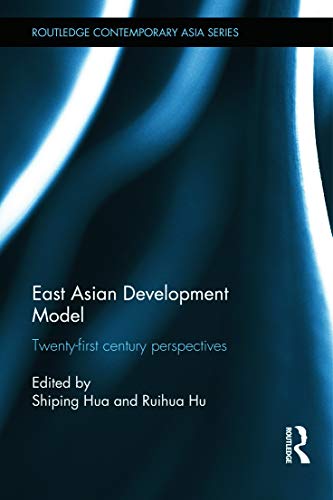
East Asian development model : Twenty-first century perspectives / edited by Shiping Hua and Ruihua Hu.
Series: Routledge contemporary Asia series ; 51.Publisher: London ; New York : Routledge, 2015Copyright date: ©2015Description: xix, 261 pages : illustrations; 25 cmContent type:- text
- unmediated
- volume
- 9780415737272 q hardback
- spine title : East Asian development model
- East Asian development model (Hua and Hu)
| Item type | Current library | Home library | Call number | Materials specified | Copy number | Status | Date due | Barcode | |
|---|---|---|---|---|---|---|---|---|---|
| AM | PERPUSTAKAAN TUN SERI LANANG | PERPUSTAKAAN TUN SERI LANANG KOLEKSI AM-P. TUN SERI LANANG (ARAS 5) | HC460.5.E27374A753 (Browse shelf(Opens below)) | 1 | Available | 00002154080 |
Includes bibliographical references and index.
Introduction : the East Asian development model / Shiping Hua -- Need for a paradigm change for the East Asian economy / Yoon-shik Park -- The use of nationalist ideology in the economic development of South Korea : implications for East Asian development model / Changzoo Song -- Democratic development and authoritarian development compared : South Korea / Hyug-Baeg Im -- Japan-South Korea economic ties : stability and growth through discord / Terence Roehrig -- The development of Japan's developmental state : stages of growth and the social costs of energy and export promotion policies / Brian Woodall -- A tale of two capitalisms : developmentalism, neoliberalism and the Japanese postal system / Patricia Maclachlan -- The political economy of digital television transition in Japan and the United States : how well can a coordinated market economy solve a coordination problem? / Henry Laurence -- The Beijing consensus, the world capitalist system and the limits of globalization / Peter Moody -- China's development path : joys and worries / Weixing (Mark) Chen -- Two models of economic development in China / Kate Zhou and Stephen Zierak -- The mass line model : East Asian democratic model / John Kennedy and Shi Yaojiang -- Beyond win-win : rethinking China's international relationships in an era of economic uncertainty / Brantly Womack.
'Given the impressive growth in East Asia after World War II, initially led by Japan, the region's development models have been scrutinized since the 1980s. The shared Confucian cultural heritage, strong government guidance, and export led economies were often cited as contributors to the impressive growth. However, major changes have taken place in Asia on and around the turn of the century: Japan experienced two decades of economic slow-down, while China has become the second largest economy in the world. Bearing this in mind, is it even possible to formulate an East Asian development model in the context of a shifting 21st century? And if so, what is it? This book addresses this issue by looking at the economic, political and cultural perspectives of China, Japan and South Korea, focusing on dynamism and potential consensus regarding an East Asian development model. The chapters offer a historical background to the East Asian development model, as well as in-depth case studies of each of the countries concerned to show that whilst the East Asian development does have distinct characteristics as compared with other areas, and other countries may draw some insights from the East Asian experience, it is not a panacea that fits all circumstances and fits all times'-- Provided by publisher.
There are no comments on this title.