
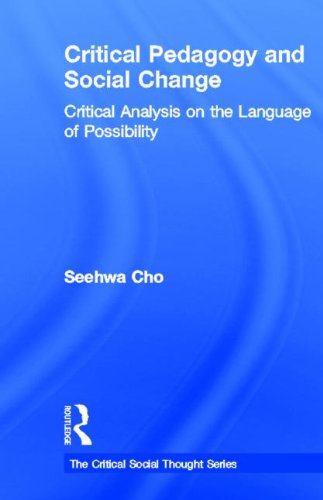
Critical pedagogy and social change : critical analysis on the language of possibility / Seehwa Cho.
Series: Critical social thoughtPublisher: New York : Routledge, 2013Description: xvi, 193 pages ; 20 cmContent type:- text
- unmediated
- volume
- 9780415886109 (hbk.)
- 0415886104 (hbk.)
- 9780415886116 (pbk.)
- 0415886112 (pbk.)
| Item type | Current library | Home library | Call number | Materials specified | Copy number | Status | Date due | Barcode | |
|---|---|---|---|---|---|---|---|---|---|
| AM | PERPUSTAKAAN TUN SERI LANANG | PERPUSTAKAAN TUN SERI LANANG KOLEKSI AM-P. TUN SERI LANANG (ARAS 5) | LC196.C496 (Browse shelf(Opens below)) | 1 | Available | 00002116162 |
Includes bibliographical references (pages 168-183) and index.
At its core, the main goal of critical pedagogy is deceptively simple--to construct schools and education as agents of change. While noble and ambitious, it is not always realistic in a climate of increased commodification, privatization of schooling, and canned curriculum. By assuming rather than articulating its own possibilities, critical pedagogy literature itself is often its own worst enemy in its call for transformation. With such challenges from both within and without, is the idea of liberatory pedagogy for social change out of reach or can critical educators really achieve the rather high call for social change? What alternative visions of schooling does critical pedagogy truly offer against the mainstream pedagogy? In short, what are the political projects of critical pedagogy? This powerful and accessible text breaks with tradition by teasing out mere assumptions, and provides a concrete illustration and critique of today's critical pedagogy. Veteran teacher educator Seehwa Cho begins the book with an engaging overview of the history of critical pedagogy and a clear, concise breakdown of key concepts and terms. Not content to hide behind rhetoric, Cho forces herself and the reader to question the most basic assumptions of critical pedagogy, such as what a vision of social change really means. After a thoughtful and pithy analysis of the politics, possibilities and agendas of mainstream critical pedagogy, Cho takes the provocative step of arguing that these dominant discourses are ultimately what stifle the possibility for true social change. Without focusing on micro-level approaches to alternatives, Cho concludes by laying out some basic principles and future directions for critical pedagogy. Both accessible and provocative, Critical Pedagogy and Social Change is a significant contribution to the debates over critical pedagogy and a fresh, much-needed examination of teaching and learning for social justice in the classroom and community beyond.
There are no comments on this title.