
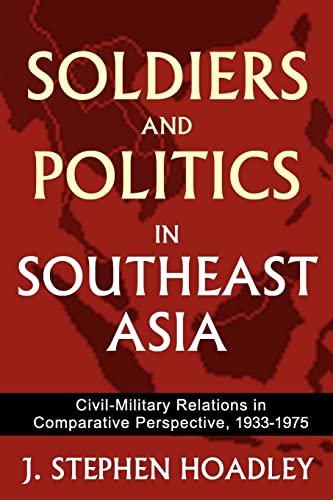
Soldiers and politics in Southeast Asia : civil-military relations in comparative perspective, 1933-1975 / J. Stephen Hoadley.
Publication details: New Brunswick : Transaction Publishers, 2012.Description: xii, 307 p. : ill. ; 23 cmISBN:- 9781412847360 (pbk.)
| Item type | Current library | Home library | Call number | Materials specified | Copy number | Status | Date due | Barcode | |
|---|---|---|---|---|---|---|---|---|---|
| KOLEKSI ASIA TENGGARA | PERPUSTAKAAN TUN SERI LANANG | PERPUSTAKAAN TUN SERI LANANG KOLEKSI ASIA TENGGARA-P. TUN SERI LANANG (ARAS 5) | JQ750.A38C586 kat (Browse shelf(Opens below)) | 1 | Available | 00002106416 |
'Originally published in 1975 by Schenkman Publishing Company'--T.p. verso.
Includes index.
'The Cold War brought about increasing interest from scholars in the politics of national development and, in the case of civilian-led underdeveloped countries, the effects of military insurgency. Two ideologically opposed positions evolved around the phenomenon of military insurgency. The position of technological conservatism favors military insurgency in previously civilian-led governments on the presumption that it encourages stability, efficiency, and, importantly, anti-communism. The revisionist position, on the other hand, is highly critical of technological conservatism, especially with regard to its political fervor. J. Stephen Hoadley asserts that the relevant question is not one of ideological choices; rather, it is whether a military or civilian-led government is better suited for the political and economic development of a particular underdeveloped nation. Soldiers and Politics in Southeast Asia introduces the reader to the sequences of events that led to military predominance in Thailand, Burma, South Vietnam, Indonesia, and Cambodia. Hoadley uses the data of five case studies to test and quantify his hypotheses. The author characterizes governments controlled by the military as performing slightly less well than civilian-led governments in Southeast Asia. Hoadley argues that while they are demonstrably less capable in responding to outside and domestic challenges, there is little difference between military and civilian-led governments in the areas of establishing stability and maintaining law. The book concludes that neither the conservative nor radical views are fully correct as to the effects of military-led governments on development.'--Publisher's description.
There are no comments on this title.