
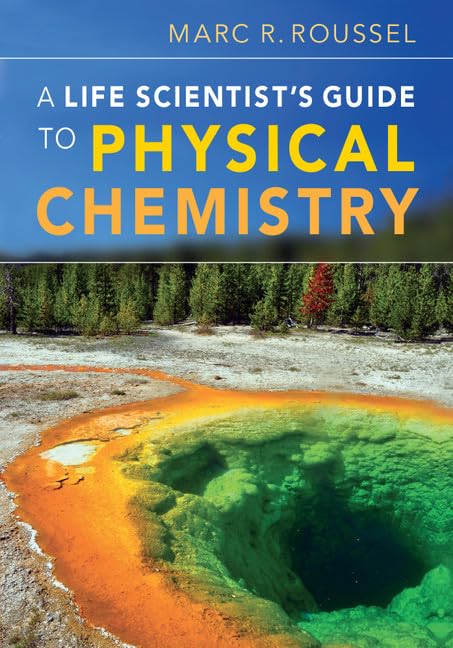
A life scientist's guide to physical chemistry / Marc R. Roussel, Department of Chemistry and Biochemistry, University of Lethbrige, Canada..
Publisher: Cambridge : Cambridge University Press, 2012Copyright date: ©2012Description: xiv, 442 pages : illustrations ; 26 cmContent type:- text
- unmediated
- volume
- 9781107006782 (hardback)
- 9780521186964 (paperback)
- Chemistry, Physical and theoretical -- Problems, exercises, etc
- Chemistry, Physical and theoretical -- Mathematics
- Chemistry, Physical and theoretical -- Textbooks
- Life sciences -- Problems, exercises, etc
- Life sciences -- Mathematics
- Life sciences -- Textbooks
- SCIENCE / Life Sciences / Biology / Molecular Biology
| Item type | Current library | Home library | Call number | Materials specified | Copy number | Status | Date due | Barcode | |
|---|---|---|---|---|---|---|---|---|---|
| AM | PERPUSTAKAAN PRAKLINIKAL | PERPUSTAKAAN PRAKLINIKAL KOLEKSI AM-P. PRAKLINIKAL | QD456.R852L 2012 9HUKMPRA (Browse shelf(Opens below)) | 1 | Available | 00002128118 | |||
| AM | PERPUSTAKAAN TUN SERI LANANG | PERPUSTAKAAN TUN SERI LANANG KOLEKSI AM-P. TUN SERI LANANG (ARAS 5) | QD456.R686 (Browse shelf(Opens below)) | 1 | Available | 00002098472 |
Includes bibliographical references and index.
Machine generated contents note: Preface; 1. Orientation: what is physical chemistry about?; A note on graph axis labels and table headings; Part I. Quantum Mechanics and Spectroscopy: 2. A quick tour of quantum mechanical ideas; 3. Spectroscopy; Part II. Thermodynamics: 4. Thermodynamics preliminaries; 5. The first law; 6. The second law of thermodynamics; 7. Free energy; 8. Chemical equilibrium and coupled reactions; 9. Non-ideal behavior; 10. Electrochemistry; Part III. Kinetics: 11. Basics of chemical kinetics; 12. Initial rate experiments and simple empirical rate laws; 13. Integrated rate laws; 14. Complex reactions; 15. Enzyme kinetics; 16. Techniques for studying fast reactions; 17. Factors that affect the rate constant; 18. Diffusion and reactions in solution; Appendix A. End-of-term review problems; Appendix B. Answers to exercises; Appendix C. Standard thermodynamic properties at 298.15K and 1 bar; Appendix D. Standard reduction potentials at 298.15K; Appendix E. Physical properties of water; Appendix F. The SI system of units; Appendix G. Universal constants and conversion factors; Appendix H. Periodic table of the elements, with molar masses; Appendix I. Selected isotopic masses and abundances; Appendix J. Exponentials and logarithms; Appendix K. Review of integral calculus; Index.
'Motivating students to engage with physical chemistry through biological examples, this textbook demonstrates how the tools of physical chemistry can be used to illuminate biological questions. It clearly explains key principles and their relevance to life science students, using only the most straightforward and relevant mathematical tools. More than 350 exercises are spread throughout the chapters, covering a wide range of biological applications and explaining issues that students often find challenging. These, along with problems at the end of each chapter and end-of-term review questions, encourage active and continuous study. Over 130 worked examples, many deriving directly from life sciences, help students connect principles and theories to their own laboratory studies. Connections between experimental measurements and key theoretical quantities are frequently highlighted and reinforced. Answers to the exercises are included in the book. Fully worked solutions and answers to the review problems, password-protected for instructors, are available at www.cambridge.org/roussel'-- Provided by publisher.
There are no comments on this title.