
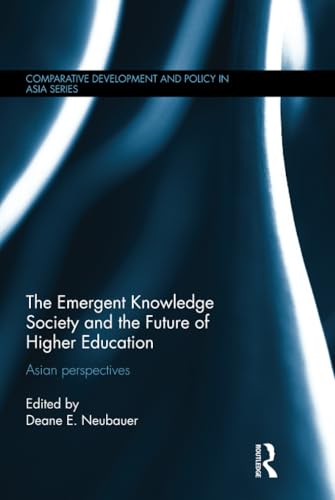
The emergent knowledge society and the future of higher education : Asian perspectives / edited by Deane E. Neubauer.
Series: Comparative development and policy in Asia ; 10Publication details: Milton Park, Abingdon, Oxon : Routledge, 2012.Description: xiii, 223 p. : ill. ; 24 cmISBN:- 9780415608695 (hardback)
- 9780203145906 (ebook)
| Item type | Current library | Home library | Call number | Materials specified | Copy number | Status | Date due | Barcode | |
|---|---|---|---|---|---|---|---|---|---|
| AM | PERPUSTAKAAN UNDANG-UNDANG | PERPUSTAKAAN UNDANG-UNDANG KOLEKSI AM-P. UNDANG-UNDANG | C36.5KP.E473 2 (Browse shelf(Opens below)) | 1 | Available | 00001518190 |
Includes bibliographical references and index.
Includes bibliographical refrences and index.
'The nature of higher education is by no means fixed: it has evolved over time; different models of higher education co-exist alongside each other at present; and, worldwide, there are demands for higher education to change to better help support economic growth and to better fit chagning social and economic circumstances. This book examines, from an Asian perspective, the debates about how higher education should change. It considers questions of funding, and of who will attend universities, and the fundamental question of what universities are for, especially as the three key funcations of universities - knowledge creation through research, knowledge dissemination through teaching and service, and knowledge conservation through libraries, the disciplinary structuring of knowledge and in other ways - are increasingly being carried out much more widely outside universities in the new'knowledge society'. Throughout, the book discusses the extent to which the countries of East Asia are developing new models of higher education, thereby better preparing themselves for the'new'knowledge society', rather than simply following old Western models'-- Provided by publisher.
'This book examines, from an Asian perspective, the debates about how higher education should change. It considers questions of funding, and of who will attend universities, and the fundamental question of what universities are for, especially as the three key funcations of universities - knowledge creation through research, knowledge dissemination through teaching and service, and knowledge conservation through libraries, the disciplinary structuring of knowledge and in other ways - are increasingly being carried out much more widely outside universities in the new'knowledge society''-- Provided by publisher.
There are no comments on this title.